
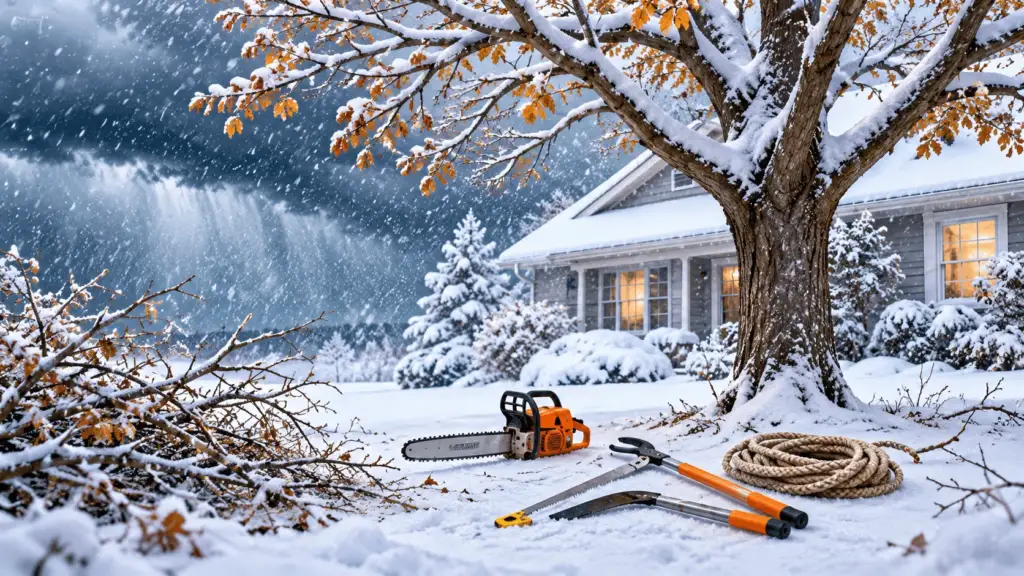
There’s a particular sound homeowners in Boston and Eden know too well: that slow, creaking groan from the backyard at 2 a.m. during the first big lake-effect event of the season — followed by a crack that means somebody’s losing a limb, a fence, or worse.
Living in the Boston hills, you get the Lake Erie special: bands of dense, wet snow that can dump a foot or more in hours and load every branch with more weight than it carried all year. Our crew at Boston NY Tree Service spends every November through January cleaning up what those bands do to unprepared trees — snapped maple leaders, split spruces, willows folded over driveways. And here’s the honest truth we tell every customer: most of that damage was preventable in October.
So before the lake does its thing, here’s the same 7-step storm-proofing checklist we use on our own properties, written for homeowners in Boston, Eden, Hamburg, and the surrounding Southtowns.
Why Lake-Effect Snow Is So Hard on Trees
Not all snow is equal. The lake-effect snow that forms over the relatively warm waters of Lake Erie is often dense and wet — the heavy, packing kind — and it tends to arrive in narrow, intense bands that bury one town while the next one over sees flurries. Anyone who watched the Southtowns disappear under several feet of snow in November 2022 knows exactly how localized and violent these storms get. The National Weather Service in Buffalo tracks these bands closely, and the Boston hills’ elevation makes our area a frequent target.
For trees, the physics are simple and unforgiving: wet snow can add hundreds of pounds of load to a mature tree’s canopy. Branches that handled summer thunderstorms without complaint suddenly carry weight they were never built for. Add a little wind off the lake, and weak unions, deadwood, and overextended limbs start failing — usually onto whatever’s underneath them.
Early-season storms are the worst offenders. If a heavy band lands in late October or early November while some trees still hold their leaves, the snow piles onto all that extra surface area and the damage multiplies. That’s why this checklist is an October job, not a December one.
The 7-Step Storm-Proofing Checklist
Walk Your Property and Really Look Up
Pick a calm day, walk the yard, and inspect every tree from trunk to tips. You’re looking for the warning signs we check on every assessment:
- Dead or hanging branches — bare limbs on an otherwise leafy tree, peeling bark, or branches already cracked and resting in the canopy (“hangers”). These come down first in snow.
- Cracks and splits — vertical cracks in the trunk or where big limbs meet, especially on multi-stemmed trees.
- Tight, V-shaped unions — two trunks or limbs meeting in a narrow “V” with bark pinched between them are far weaker than a wide U-shape, and they’re a classic snow-load failure point.
- Fungus and root trouble — mushrooms at the base, heaving soil, or a new lean can mean root decay — the kind of problem that drops a whole tree, not just a branch.
Take photos of anything questionable. They’re useful when you call a pro, and they matter for insurance documentation if something fails later.
Prune Deadwood and Overextended Limbs — Now, Not in January
Pruning is the single most effective thing you can do to protect trees from snow damage. Removing deadwood takes away the branches most likely to fail, and reducing long, horizontal, overextended limbs cuts the leverage that heavy snow uses to tear them off. Late fall is also the start of the dormant season — an excellent time to prune most species in Western New York. The tree’s structure is visible and cuts heal cleanly come spring.
A homeowner with a pole pruner can safely handle small, low deadwood. Anything that requires a ladder, a chainsaw overhead, or work near a structure or wire belongs to a professional crew — November emergency rooms see enough of those accidents already.
Cable or Brace Trees Worth Saving
Some trees have structural weak points but are too valuable — or too beloved — to remove. That big double-trunked maple shading your deck, for instance. For trees like these, support systems (cables installed high in the canopy, or rods through weak unions) let the stems share load instead of prying apart under snow weight.
This is specialized work: the hardware has to be rated, placed, and tensioned correctly, or it does more harm than good. If you’ve got a split-prone tree you want to keep, have it evaluated before the snow flies — installing a cable in October is routine; doing it after a partial failure in December is often impossible.
Protect Young and Newly Planted Trees
The trees most likely to be ruined for life by one bad winter are the young ones. Three things worth doing before the first storm:
- Stake new plantings loosely so they can flex but not snap or uproot under wind-driven snow.
- Tie up narrow evergreens — columnar arborvitae and junipers splay open under wet snow. Loosely spiraling them with soft rope or burlap strips keeps the branches from folding outward. This is the one case where “wrapping” a tree for winter makes real sense.
- Mulch the root zone — a 2–3 inch ring (kept off the trunk) insulates roots against the freeze-thaw cycles our area is famous for.
Clear What’s Hanging Over Roofs, Driveways, and Lines
Stand at your house and look at what’s directly above it. Any limb overhanging the roof, garage, driveway, or your electrical service drop is a limb that lands on them when loaded with snow. Ten feet of clearance over a roofline is a good rule of thumb.
One safety note we can’t repeat enough: if a branch is growing into or near power lines, don’t touch it — not even with a pole pruner. Line-adjacent work needs to be coordinated with your utility (NYSEG or National Grid, depending on your road). We handle those calls for our customers regularly.
Plan Where the Snow Goes
This one costs nothing and saves trees every winter. When you (or your plow guy) clear the driveway, don’t pile snow against trunks or on top of shrubs and young trees. Compacted plow piles break branches, smother root zones, and the salt mixed in burns roots come spring. Pick a snow dump zone away from your plantings now — because at 6 a.m. in a whiteout, nobody’s thinking about the arborvitae.
Book a Professional Pre-Winter Inspection
Steps 1 through 6 catch the obvious. A trained eye catches the rest — the hollow spot you can’t see, the root flare problem, the union that’s one storm from splitting. A pre-winter assessment from Boston NY Tree Service takes under an hour for most properties: we walk the yard with you, flag anything risky, prioritize honestly (most trees pass!), and quote any work in writing. No pressure, no invented problems — half the time the answer is “your trees look good, here’s the one limb we’d take off.”
How Do I Protect My Trees from Heavy Snow?
If you only remember three things from this article, make them these:
- Reduce the load before it arrives. Prune out deadwood and shorten overextended limbs so there’s less for snow to grab.
- Support what’s weak. Cable split-prone unions, stake young trees, tie up narrow evergreens.
- Don’t knock snow off with force. If branches are bent under snow, you can gently push upward on small ones with a broom to shed the load. Never shake, whack, or pull downward on a loaded branch — frozen wood is brittle, and you’ll snap what the snow was only bending. If it’s ice rather than snow, leave it alone entirely and let it melt.
What Trees Are Most Likely to Fall in a Storm?
After years of storm cleanup across the Southtowns, our call log is remarkably predictable. The usual suspects:
- Silver maples — fast-growing, brittle, usually multi-stemmed with weak unions. The number-one source of storm damage calls in our area.
- Willows and poplars — soft, fast-grown wood that sheds limbs in nearly every major event.
- Bradford/callery pears — their tight branch structure practically engineers them to split in heavy snow.
- Dead and dying ash — the emerald ash borer killed huge numbers of ash across Western New York, and standing dead ash is brittle, unpredictable, and dangerous. If you still have one near a structure, make it priority one.
- Anything with existing defects — species matters less than condition. A compromised oak is more dangerous than a healthy willow. That’s why the inspection in Step 1 matters more than any species list.
Should I Wrap My Trees for Winter?
Mostly no, with two exceptions. Wrapping mature trees in burlap for snow protection is wasted effort — no wrap stops a hundred pounds of wet snow on a limb. The cases where wrapping genuinely helps:
- Narrow evergreens (as covered in Step 4) — a loose spiral tie keeps columnar arborvitae and junipers from splaying.
- Thin-barked young trees (maples, lindens, fruit trees) can benefit from a light-colored trunk guard against sunscald — winter sun warming the bark by day and the cold cracking it at night — and against rabbits and voles gnawing bark under the snowpack. Remove guards in spring.
Skip plastic wraps that trap moisture, and never wrap so tight that bark can’t breathe.
Quick FAQs from Southtowns Homeowners
When should I do all this?
October through early November is the sweet spot — after most leaves drop but before the first major band. That said, a mild December week works fine for pruning; dormant-season pruning is good practice all winter.
A branch is already bent under snow — will it recover?
Often, yes. Healthy wood is springy, and many bent branches straighten over days or weeks after the snow sheds. Give them time before cutting. If a branch is cracked, split, or hanging, that’s different — it won’t heal, and it should come off cleanly before it tears bark on the way down.
What do I do if a tree fails during a storm?
Stay away from anything touching a power line and call your utility first. For everything else — a tree on the house, a blocked driveway, a hanger over the kids’ play area — our 24/7 emergency tree service in Boston, NY responds around the clock, all winter. Save the number now: (716) 456-8833.
Does homeowners insurance cover storm damage to trees?
Generally, insurance helps when a tree damages a covered structure during a storm — but a tree that was visibly dead or neglected beforehand can be denied as negligence. That’s one more argument for a documented fall inspection. We covered this in detail in our guide to tree removal costs in Boston, NY.
Can I tackle any of this myself?
Some of it, yes. Staking a young tree, loosely tying up arborvitae, mulching root zones, and removing small low deadwood with a pole pruner are all reasonable DIY tasks. Anything involving a ladder, a chainsaw, or proximity to a structure or wire belongs to a trained crew — the savings rarely cover the risk.
A Local Crew That Knows What the Lake Does
Boston NY Tree Service is locally based, and in this line of work that’s not a slogan — it’s the difference between generic advice and knowing that the hills above Boston catch bands that miss Hamburg entirely, that Eden’s open farm edges funnel wind into yard trees, and which roads the plows bury last. That local experience shows up in safer jobs, more accurate quotes, and no surprises on the invoice.
Beyond storm prep, our crew handles tree trimming and pruning, hazard assessments, cabling, storm cleanup, and 24/7 emergency removal across Boston, Eden, Hamburg, Orchard Park, and the surrounding Erie County towns — with free written estimates and industry-standard safety practices on every job.
