
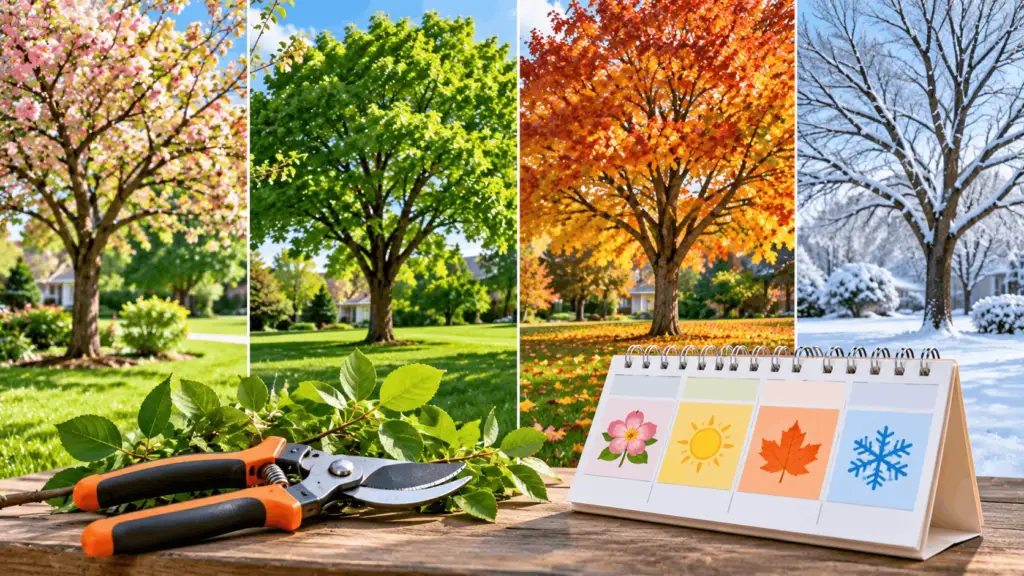
Ask ten people around Boston, NY when to trim their trees and you’ll get ten different answers. Some swear by early spring, some say summer, and a surprising number assume it doesn’t matter — “just whenever it needs it.” The truth is timing is one of the most important pruning decisions you can make, and getting it wrong doesn’t always kill a tree outright but it can make a healthy tree more vulnerable to disease, slow its healing, and create problems you’ll be dealing with for years.
At Boston NY Tree Service, we trim trees every month of the year — storm cleanup doesn’t wait for a good season — but when a homeowner asks us when they should schedule their trimming, we always give the same honest answer: late fall and winter, for most trees. Here’s the full picture, broken down by season and species, so you can make an informed call for whatever’s growing in your yard.
Why Pruning Timing Matters More Than Most People Realize
Trees don’t just sit there passively while you cut them. Every pruning wound triggers a biological response — the tree compartmentalizes the cut, walls off the wound, and eventually grows new tissue over it. That process works best when the tree has energy to spare and conditions that support fast healing. Time the cut wrong and you’re asking the tree to respond when it’s already stressed, actively growing, or at peak vulnerability to insects and disease.
Two examples that come up regularly in Western New York:
- Oak wilt. Oak trees pruned between mid-April and mid-July — when bark beetles are most active and moving between trees — are at serious risk of oak wilt, a devastating fungal disease that travels fast and kills trees that took decades to grow. The fix is simple: trim oaks in full winter dormancy and you essentially close the door on the main infection pathway.
- Sap bleeding on maples and birches. Prune a maple or birch in early spring and you’ll see sap flowing freely from the cuts. It won’t hurt the tree long-term, but it’s messy, the sap attracts insects, and it’s completely avoidable. Wait until leaf-out is underway and the pressure equalizes.
The good news is that for the vast majority of trees in our area — maples, oaks, lindens, pines, spruce, ash — late fall and winter are both safe and optimal. You’re not fighting the tree; you’re working with it.
Western New York Tree Pruning Calendar
Here’s how timing breaks down across the year for homeowners in Boston, West Seneca, Orchard Park, and the surrounding area:
| Season | Timing | Best For | What to Avoid |
|---|---|---|---|
| Late Fall Nov–Dec |
After leaves drop, before hard freeze | Most deciduous trees: maples, oaks, ash, birch, linden. Dead & crossing branch removal. | Don’t start major cuts on oaks — wait until full dormancy. |
| Winter Jan–Feb |
Full dormancy — our recommended window | Everything except spring bloomers. Structure is fully visible. Cuts heal fastest come spring. | Avoid pruning spring-blooming trees (lilac, crabapple, magnolia) — you’ll cut off next year’s buds. |
| Early Spring Mar–Apr |
Just before or at bud break | Fruit trees, spring bloomers (prune right after they flower). Last chance for dormant work on most species. | Skip maples & birch — they bleed sap heavily. It won’t kill them, but it’s messy and unnecessary. |
| Summer Jun–Aug |
Active growing season | Deadwood removal, light corrective trimming, clearance pruning. Emergency work any time. | Avoid heavy structural cuts — the tree is spending energy on growth, not healing. Wait for dormancy. |
*This calendar reflects typical conditions in Erie and Niagara County. An unusually warm fall or late spring can shift the optimal windows slightly — your arborist can advise based on current conditions.
Best Pruning Time by Tree Species (Western New York Guide)
Species matter more than most guides admit. Here’s what we see on the job:
Silver Maple & Red Maple
Maples are extremely common in Boston, Hamburg, and West Seneca yards, and they’re forgiving pruners. Any time except early spring (March–April) when sap runs. Late fall through February is ideal. Silver maples especially benefit from regular structural pruning — their fast growth and weak branch unions make early intervention a lot cheaper than emergency work later.
Oak (Red, White, Pin)
Winter only — December through early April at the latest. Michigan DNR and MSU Extension both confirm the high-risk window runs from mid-April through mid-July, when bark beetles are most active and can carry the oak wilt fungus directly into fresh pruning wounds. Prune in full dormancy and you essentially close the door on the main infection pathway. If you must prune an oak outside that window for safety reasons, seal the wound immediately with tree wound paint.
Ash (If You Still Have One)
The emerald ash borer has taken most ash trees across Western New York, but some treated and surviving ash remain. Treat these like oaks — full dormancy, winter months. Dead ash should be removed as soon as it’s identified; standing dead ash is brittle, unpredictable, and dangerous near structures.
Fruit Trees (Apple, Pear, Cherry, Plum)
Late winter through early spring — late February through mid-March in a typical year, though a late WNY winter can push this into early April. This is the classic orchard pruning window and it applies to ornamental fruit trees too. You can see the structure clearly, the tree responds aggressively with new growth, and you’re ahead of the insects and disease pressure that picks up in spring.
Crabapple, Lilac, Magnolia, Forsythia
These are spring bloomers — they set next year’s flower buds in summer and fall. Prune them in winter or early spring and you’ll cut off all those buds and have no flowers that year. Prune right after they finish blooming — usually late May through mid-June — and you get the structural benefit without losing the show.
Spruce, Pine, and Other Conifers
Late spring to early summer, right after new growth (candles) has extended but before it hardens. This timing keeps conifers dense and compact. For dead or diseased branch removal, any time is fine — dormancy isn’t as critical for most conifers as it is for susceptible deciduous species.
Arborvitae, Juniper, Boxwood
These can be lightly shaped almost any time except late fall, when new growth won’t have time to harden before the first hard freeze. Late spring through mid-summer is best for shaping. Avoid heavy cutting on arborvitae in particular — unlike most conifers, they won’t regenerate from old wood.
What Month Should Trees Be Trimmed?
For most Western New York homeowners, November through February is the sweet spot. Here’s the practical breakdown by what you’re trying to accomplish:
- Structural pruning (removing crossing branches, shaping the crown, reducing load over roofs): November–February. Full dormancy, maximum visibility, fastest healing.
- Deadwood removal: Any time — but it’s most efficient bundled with winter structural work.
- Clearance trimming (lifting branches over roofs, driveways, power lines): Any time, though winter is easiest on the lawn since the ground is often frozen.
- Spring-blooming trees: Right after flowering — typically late May through mid-June.
- Fruit tree shaping: Late February through mid-March in a typical year; a late WNY winter can push this to early April.
If you’re not sure what category your trees fall into, that’s exactly what a pre-season assessment is for. We’ll look at what’s in your yard and tell you honestly what can wait and what should happen this winter.
Can You Trim Trees in Winter?
Not only can you — for most trees, you should. Winter is when professional tree crews do their best structural work, and there are good reasons why:
- No leaves = full visibility. You can see every branch, every union, every crossing limb clearly. Trying to assess a maple’s structure in July is like trying to read a map through a shower curtain.
- Pests and pathogens are dormant. Many of the insects and fungi that enter through pruning cuts — oak wilt, Dutch elm disease, various boring beetles — are either inactive or not yet flying in winter.
- Frozen ground protects your yard. Equipment ruts and compaction are a real issue in wet spring and fall soil. In January, frozen ground often means our crew can get in and out without leaving a trace on your lawn.
- Trees heal faster from dormant cuts. A wound made in January is ready to start compartmentalizing as soon as growth begins in spring. The same cut made in June is competing with the tree’s active growth demands.
The main exception is severe cold. Our crew avoids making major cuts during extreme cold snaps because wood becomes more brittle and some species can be stressed by large wounds in very low temperatures. But a typical Western New York January or February day is fine — we work through winter all season long.
Frequently Asked Questions
How often should trees be pruned?
Most mature shade trees benefit from an assessment every 3–5 years and structural pruning every 5–7 years, with annual or biennial clearance trimming as needed for branches over roofs and structures. Young trees (under 10 years) benefit from more frequent formative pruning — getting the structure right early costs a fraction of correcting problems later.
What happens if you prune at the wrong time?
It depends on the species and how wrong. For most trees, off-season pruning causes slower wound closure, some cosmetic weeping (sap), and mildly increased stress — survivable. For oaks pruned between mid-April and mid-July, the risk is oak wilt, which can kill a tree within weeks and spread to neighbors. For spring bloomers pruned in winter, the consequence is simply no flowers that year. The worst outcomes involve stress-on-stress: a tree that’s already struggling and then gets a large wound in hot, dry summer weather.
Should I prune my own trees?
Light maintenance — removing small deadwood with a pole pruner from the ground, shaping shrubs and small ornamentals, cutting back arborvitae — is reasonable DIY work. Once the work requires climbing, a chainsaw, a ladder, or positioning near a structure or utility line, that’s when to call. The savings from DIY on a large tree rarely cover the ER visit or the roof damage if something goes wrong. Our tree trimming and pruning service covers everything from routine maintenance to complex structural work.
Does pruning timing differ for young trees vs. mature trees?
Yes. Young trees benefit most from formative pruning — establishing good structure before bad habits develop. This can happen almost any time you see a problem crossing branch or competing leader developing, though the dormant season is still preferred for major cuts. Mature trees need less frequent intervention but more careful timing, since larger wounds take longer to close and the consequences of a stress-triggered disease are bigger.
Local Knowledge That Changes the Advice
Boston NY Tree Service works across Boston, West Seneca, Orchard Park, Hamburg, Eden, and the surrounding Erie County towns, which means the pruning advice we give isn’t pulled from a national guide. It reflects what actually works in our climate — the lake-effect snow that breaks unprepared branches, the wet spring soils that make early-access jobs more damaging than they’re worth, the oak wilt pressure that made us strict about dormant-season cuts years before it became a headline issue.
If you’re not sure where to start, our tree trimming and pruning service includes a free pre-season walkthrough where we assess what’s in your yard, flag anything that needs attention before winter, and quote the work in writing. And if you’ve had a rough winter already, check our storm-proofing checklist for Boston and Eden homeowners for the steps we recommend before the first lake-effect band rolls in.
