If you’ve been staring at that leaning silver maple in your backyard wondering what it’s going to cost to take it down, you’re not alone. It’s one of the most common questions we get from homeowners across Boston, Hamburg, and Eden—usually right after a windy night or when a big limb ends up on the lawn.
The honest answer is: it depends. But “it depends” isn’t helpful when you’re trying to budget, so in this guide our crew at Boston NY Tree Service breaks down real-world tree removal cost in Boston, NY—what drives the price up, what brings it down, when insurance helps, whether you need a permit in Erie County, and how to avoid overpaying. We’ve spent years climbing, cutting, and hauling trees all over the Southtowns, so everything below comes from jobs we actually do, not national averages copied from somewhere else.
The Short Answer: Average Tree Removal Cost in Boston, NY
Here’s what tree removal typically costs in our corner of Western New York. These are scheduled, non-emergency removals with normal access:
| Tree Size | Typical Cost Range* | Common Examples in Our Area |
|---|---|---|
| Small (under 25 ft) | $300–$700 | Ornamental crabapples, young maples, arborvitae |
| Medium (25–50 ft) | $600–$1,200 | Mature maples, birches, spruce along fence lines |
| Large (50–80 ft) | $1,200–$2,500 | Old silver maples, oaks, tall pines near the house |
| Extra-large / hazardous (80 ft+) | $2,500–$4,500+ | Storm-weakened cottonwoods, dying ash, trees over power lines |
*Ranges reflect typical local projects and are for planning purposes only. Your written estimate may differ—see the disclaimer at the end of this article.
Notice how wide those ranges are? Two 60-foot maples can cost very different amounts to remove. One stands in an open yard where we can drop it in sections with room to work. The other leans over a garage with a chain-link fence on one side and a neighbor’s shed on the other. Same species, same height—very different job.
How Much Does It Cost to Remove a Large Tree?
This is the question behind most calls we get, because Boston, NY doesn’t grow small trees. Our older neighborhoods and rural lots are full of mature silver maples, oaks, pines, and the occasional giant cottonwood that’s been there longer than the house.
For a large tree between 50 and 80 feet, expect $1,200 to $2,500 in most cases. Once a tree passes 80 feet, or when it’s dead, storm-cracked, or tangled in utility lines, the price climbs toward $2,500–$4,500 and beyond. Here’s why big trees cost what they do:
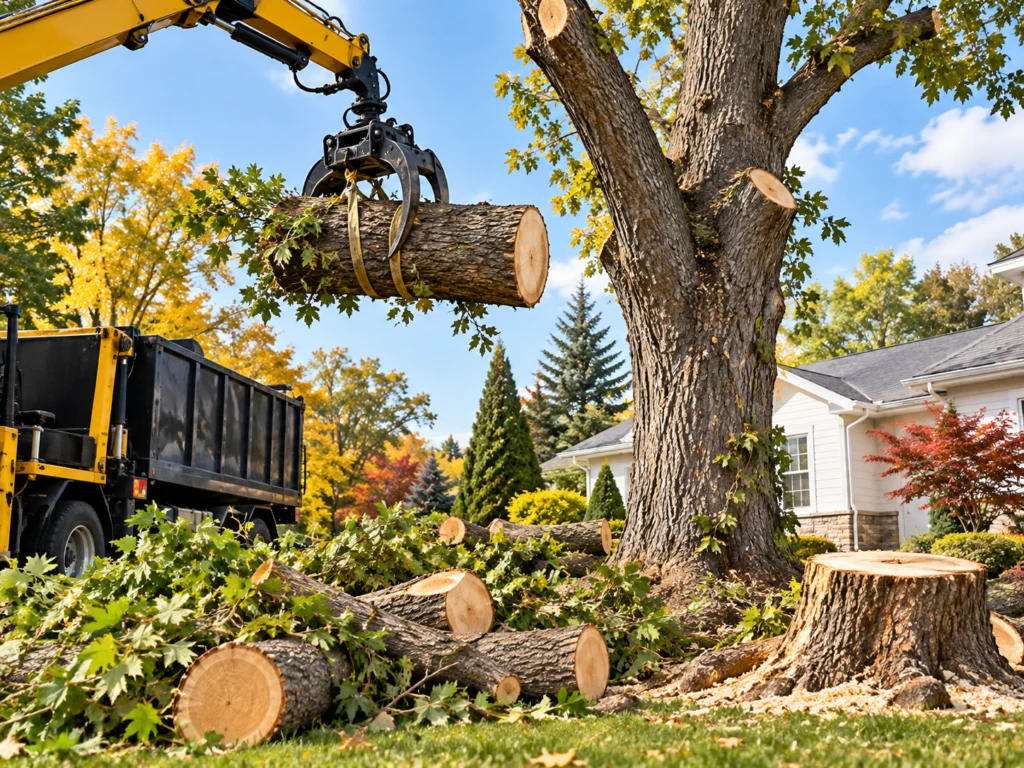
- Rigging and sectional dismantling. A large tree near a structure can’t simply be felled. Our climbers rope down each section piece by piece so nothing touches your roof, deck, or fence.
- Dead and dying trees are riskier. Dead ash (and Western New York has lost a lot of ash to the emerald ash borer) is brittle and unpredictable, which means slower, more careful work and sometimes specialized equipment.
- More wood to haul. An 80-foot maple produces a serious amount of debris. Chipping, loading, and hauling it off your property is a big part of the labor.
A good local crew will walk the property with you, point out exactly what makes your tree easy or difficult, and put the price in writing before any saw starts.
7 Factors That Decide Your Tree Removal Quote
When we build an estimate for tree removal in Boston, NY, these are the things we’re actually looking at:
- Size and height. Taller and thicker means more cutting time, more rigging, and more debris. This is the single biggest cost factor.
- Species and wood density. Oaks and hickories are heavy and hard on equipment. Pines are tall but lighter. Multi-stemmed trees like silver maples take longer to dismantle than single-trunk trees.
- Location and access. A tree in the front yard near the driveway is straightforward. A tree in a fenced backyard with no equipment access means everything comes out by hand—and that adds hours.
- Proximity to structures and power lines. Anything overhanging a roof, garage, pool, or service line demands slow, controlled rigging. Trees in contact with utility lines may also need coordination with the utility company first.
- Tree condition. Healthy trees behave predictably. Dead, hollow, or storm-damaged trees don’t, so hazardous removals are priced for the extra care they require.
- Timing. A scheduled weekday removal costs less than a 2 a.m. emergency call after a lake-effect windstorm. If a tree is declining but not yet dangerous, booking ahead saves real money.
- Cleanup and stump work. Full debris haul-away, wood left cut for firewood, stump grinding, or stump removal—each option changes the final number, so make sure your quote spells out what’s included.
Does Homeowners Insurance Cover Tree Removal?
Sometimes—and the difference usually comes down to what the tree hit.
As a general rule, if a tree falls and damages a covered structure—your house, garage, fence, or deck—your homeowners policy typically helps pay for removing the tree from that structure and repairing the damage, minus your deductible. If the same tree falls harmlessly in the yard without hitting anything, most policies treat removal as regular property maintenance and won’t pay for it, though some policies make exceptions when the fallen tree blocks your driveway. The Insurance Information Institute has a helpful plain-English overview of how this usually works.
A few local, practical notes from jobs we’ve worked:
- Take photos before anything is moved. Your adjuster will want them.
- A healthy tree that fell in a storm is usually a covered peril; a long-dead tree you ignored for years may be considered neglect and denied.
- If a neighbor’s tree lands on your property, your own policy generally handles it first—it’s rarely the fast neighborhood dispute people expect it to be.
Every policy is different, so confirm the details with your insurance agent. What we can do is provide the written estimates and documentation your claim needs, which we do regularly for homeowners around Boston and Hamburg after big wind events.
Do I Need a Permit to Remove a Tree in Erie County?
For most trees on your own private property in the Town of Boston, no permit is required to remove them—and that holds true for much of rural Erie County. The main exceptions to watch for:
- Trees in the public right-of-way. Trees between the sidewalk/road and your property line are often town- or county-maintained. Don’t touch those without checking with the highway department first.
- Protected or regulated areas. Properties near wetlands, creeks, or in certain zoning overlays can carry restrictions.
- Village and city rules differ. If you own property elsewhere in Western New York—say in Hamburg village or Buffalo proper—local tree ordinances can be stricter than the town’s.
When in doubt, one quick call to your town hall settles it, or you can start with Erie County’s official website to find the right department. As a local company, we already know which situations need a phone call before the chainsaws come out—it’s part of what you’re paying for when you hire a crew that works these towns every week.
Is Stump Grinding Included in Tree Removal?
Usually not—and this surprises a lot of first-time customers. A standard tree removal takes the tree down to a low stump, typically a few inches above grade. What happens to that stump is a separate decision with its own cost:
- Stump grinding ($100–$400 per stump in most cases). We grind the stump several inches below ground level, backfill with the grindings, and you can seed grass over it. This is the most popular option and what we recommend for most yards.
- Full stump removal. Pulling the entire root ball out of the ground. It costs more and leaves a bigger hole, but it’s the right call if you’re building, pouring concrete, or installing a fence or pool where the tree stood.
- Leaving the stump. Free, obviously—but old stumps attract carpenter ants, sprout suckers, and become mower obstacles, so most homeowners regret this one eventually.
If you want the stump gone, say so when you get your estimate. Bundling stump grinding with the removal is almost always cheaper than calling someone back out later for a single stump.
What About Emergency Tree Removal Costs?
Anyone who’s lived through a November lake-effect event or a spring windstorm off Lake Erie knows trees here don’t always fail on a convenient schedule. Emergency tree removal—a tree on the house, blocking the driveway, or hanging over a power drop—typically costs 1.5 to 2 times the price of scheduled work, reflecting the after-hours response and the added danger of cutting trees under tension.
Two pieces of honest advice from our emergency crew: first, if a tree is touching power lines, stay away and call NYSEG before anyone else. Second, the cheapest emergency removal is the one that never happens—if you’ve got a tree that’s leaning more each year, dropping big deadwood, or showing fungus at the base, have it assessed now, while it’s still a scheduled job at a scheduled price. Our emergency tree service in Boston, NY runs 24/7, but we’d genuinely rather see you before the storm than after it.
5 Ways to Keep Your Tree Removal Cost Down
- Book in the off-season. Late fall and winter are often slower for tree crews around Boston and Eden, and frozen ground actually protects your lawn from equipment. It’s a smart time to schedule non-urgent removals.
- Don’t wait on a declining tree. A dying tree only gets more dangerous—and more expensive—to remove. Dead, brittle wood takes longer and costs more than the same tree removed a year earlier.
- Bundle the work. Removing two trees in one visit, or adding stump grinding and a trim on another tree, is cheaper per item than separate appointments.
- Keep the wood if you burn it. Asking the crew to leave the trunk cut into firewood lengths can shave the haul-away cost—and around here, free hardwood is never a bad thing.
- Get a written, itemized estimate. A legitimate local company will spell out exactly what’s included—removal, cleanup, stump, haul-away—with no vague totals and no pressure. If someone knocks on your door after a storm demanding cash up front, close the door.
Quick FAQs from Boston, NY Homeowners
What’s the cheapest time of year to remove a tree?
Usually late fall through winter, when demand drops after the growing season. Dormant trees are also lighter without their leaves, which can make the work faster.
How long does a tree removal take?
A small, open-yard tree can be down and cleaned up in a couple of hours. A large tree over a structure can take most of a day. Either way, you’ll know the plan before we start.
Can I remove a tree myself to save money?
For anything taller than a one-story house, near a structure, or near any wire, please don’t. Chainsaw and tree-felling injuries fill emergency rooms every year, and a bad cut on a big tree can total a garage in seconds. DIY makes sense for shrubs and small ornamentals, not 60-foot maples.
Does a dead tree cost more to remove than a living one?
Often, yes. Dead wood is brittle and unpredictable, so climbers work slower and use more rigging. It’s one more reason not to let a dying tree stand for years.
Who pays if my neighbor’s tree falls on my property?
In most cases, your own homeowners insurance responds first, regardless of whose tree it was—unless the neighbor was clearly negligent about a known hazard. Document everything and let the insurers sort it out.
Why Boston, NY Homeowners Call a Local Crew
Boston NY Tree Service is a locally based company, and that matters more in tree work than people realize. We know how lake-effect wind loads stress the maples along Boston State Road. We know which neighborhoods lost ash trees to the borer and still have standing dead wood. We know the access quirks of rural lots in Eden and the tight backyards in Hamburg. That local experience shows up in safer jobs, more accurate quotes, and no surprises on the invoice.
Beyond tree removal, our crew handles tree trimming and pruning, stump grinding, storm cleanup, and 24/7 emergency response across Boston, Hamburg, Eden, Orchard Park, and the surrounding Erie County towns. Every job follows industry-standard safety practices, every estimate is free and transparent, and every property gets treated the way we’d treat our own.
